
Open Gamma vs. Real-Time Gamma: Which Drives SPX 0DTE Intraday Moves More?
Using RTGamma tick-level data to demonstrate why static open gamma sets the morning tone, while real-time gamma dynamics increasingly control the rest of the trading day in zero-days-to-expiration opt

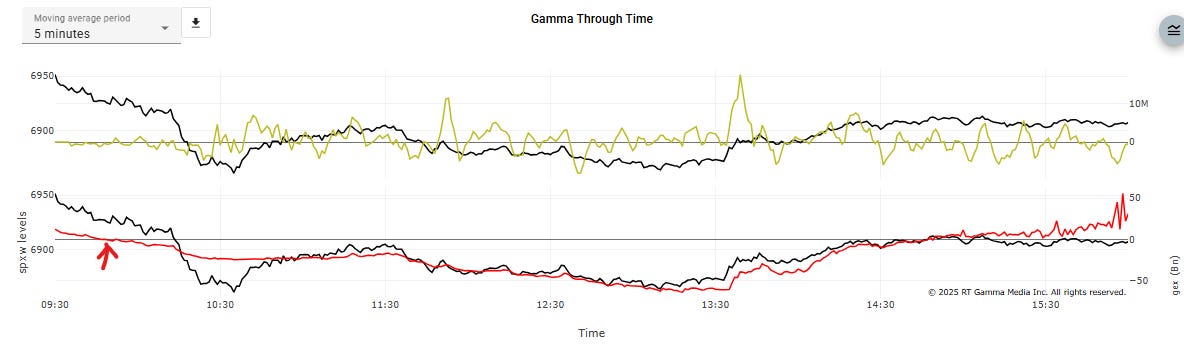
On February 26, 2026, the S&P 500 opened with positive gamma exposure centered around the 6951.7 strike. Classic gamma theory suggested this configuration would dampen volatility and promote range-bound trading in the early session.
Instead, the index declined sharply, reaching a low of 6861 by 10:35 a.m. The catalyst was clear: a positive-to-negative gamma flip registered at 9:49 a.m. on the 0DTE gamma structure. Once that flip occurred, dealer hedging flows intensified, accelerating the downside move.
This example highlights a key distinction for 0DTE traders. While open gamma provides a foundational bias for morning trading, real-time gamma is relatively more important throughout the day. It captures evolving hedging flows that can either exacerbate or suppress volatility in the high-gamma environment of zero-days-to-expiration options.
Open Gamma: Predictive in the Morning, Limited Later
Open gamma (often referred to as opening GEX) is derived from the prior day’s close using overnight open interest, strikes, and estimated dealer positioning. It serves as a static snapshot of aggregate gamma exposure at the market open.
Empirical analysis of thousands of trading days confirms its value in the early session. During the first hour of regular trading hours (9:30–10:30 a.m.), lower (negative) open GEX correlates with higher true range, while higher (positive) open GEX correlates with lower true range—precisely as gamma theory predicts. Positive gamma encourages dealers to hedge contra to price movement, stabilizing the market; negative gamma amplifies moves.
By the afternoon, however, the predictive power of open GEX largely vanishes. Correlation between open gamma levels and realized volatility drops significantly after midday. The reason is structural: open gamma is inherently static. It does not account for intraday volume shifts, new 0DTE option flows, strike migration as price evolves, or ongoing dealer re-hedging.

Real-Time Gamma: The Dynamic Driver of Intraday Action
Real-time gamma, by contrast, is a live metric updated continuously via tick-level data. It reflects the actual, evolving gamma exposure of market makers as trades execute and the underlying price moves.
In 0DTE options—where gamma intensity spikes dramatically near expiration—this dynamic view is especially powerful. Real-time gamma directly influences key market behaviors, including volatility pinning near prominent strikes, breakouts triggered by gamma flips, and rapid amplification or suppression of price action.
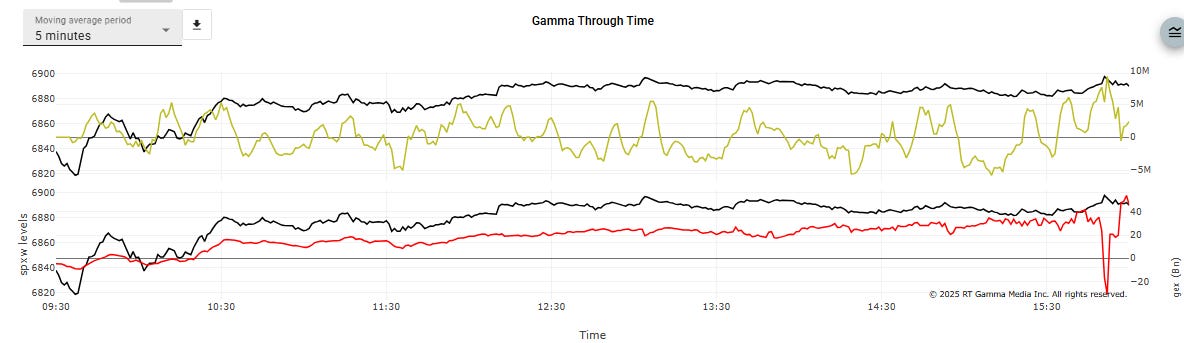
Consider February 24, 2026. The session opened with negative gamma, correctly indicating elevated volatility potential. Within the first few hours, the gamma structure flipped positive. Shortly after the flip, SPX broke out to the upside, producing a clean directional move exceeding 40 points.
Traders relying solely on the opening gamma level would have missed the inflection. Those monitoring real-time gamma identified the shift as it occurred and capitalized on the resulting momentum.
Comparative Importance: Morning vs. Afternoon
Open gamma excels at establishing initial bias and setting expectations for the first 60–90 minutes. Beyond that window, real-time gamma assumes primary control. The transition reflects the fluid nature of modern 0DTE trading, where fresh option flows continuously reshape dealer positioning.
Why Real-Time Gamma Is Gaining Prominence
The relative importance of real-time gamma has increased substantially as market structure evolves. According to Cboe data, 0DTE options now account for over 50% of total daily SPX options volume—reaching a record 63% in February 2026. This compares to approximately 21% in 2021 and just 5% in 2016.
The surge in same-day expiration volume generates far more dynamic intraday gamma shifts. New contracts are written, unwound, and adjusted throughout the session in ways that static open gamma snapshots cannot capture. As 0DTE participation continues to rise, real-time monitoring of gamma becomes essential for accurate intraday risk assessment and positioning.
Practical Implications for SPX 0DTE Traders
Effective 0DTE trading requires integrating both metrics:
Use open gamma for pre-market planning and early-session bias.
Shift primary attention to real-time gamma after 10:30–11:00 a.m. to detect flips, identify pinning levels, and anticipate hedging-driven accelerations.
In today’s environment, traders who treat gamma as a live, evolving signal—rather than a static morning indicator—gain a measurable edge in capturing the fluid hedging dynamics that drive SPX price action.
The data are unequivocal: open gamma anchors the day, but real-time gamma increasingly determines where it goes.